
Logo Design and Ancient Symbols: Cultural Roots of Visual Identity
The symbols used in artistic works primarily originate from the beliefs, values, and convictions of each society during its specific era, with a factor called social culture having a very important influence on their formation.
In some ancient societies, this cultural influence was extremely profound and intensely tangible, and those communities remained loyal to their principles, values, and norms. In this context, the manner of expressing and executing logo design and ancient symbols—the renowned myths and emblems—is also seen in the objects used in people’s daily lives.
Largely, in the traditional arts of antiquity, including in the design of logos and ancient symbols, a form of representation of nature, the universe, and the sacred concepts of each ethnicity and culture is observed. It is as if the ancient artist, acting as a representative of their era, connected themselves with nature, the cosmos, and the Creator of the universe when creating or executing artistic works and diverse symbols.
Regarding Iranian society, one might say that the importance of logo and symbol design and the use of ancient Iranian mythological motifs in the lives of Iranians was so great that it gave rise to a myth-centric and symbol-believing society, to the extent that symbol and life seemed inseparable from each other.
The Symbolic Function of Ancient Motifs
In ancient societies, the beliefs of those civilizations were manifested through various symbols specific to those cultures on flags, objects, vessels, building decorations, and other items. This highlights the importance of paying attention to logo design and ancient symbols used in various dimensions of ancient societies’ lives. This is crucial because typically, the study of ancient symbols and logos is approached from an aesthetic and superficial standpoint, while attention to the symbolic and semantic dimension of these intelligent motifs can be critically important in achieving an understanding of the designer’s original thought process.
It is not far from reality to suggest that the mythological logo design and ancient symbols were derived from natural factors that influenced human lives. Humanity attributed special characteristics to those natural elements, which ensured the continuous and daily importance of their symbolic motifs and myths.
Given that in the process of understanding symbols, we are essentially trying to establish a connection with that design and symbol, it is appropriate to cite this definition from prominent scholars in this field:
Analyzing Communication in Logo and Symbol Design
Communication with a Unique logo design and symbol is a process that includes at least four main factors:
The generating source (the Designer)
Produces a symbol or mark (The Logo Design)
For at least one receiver (The Audience)
And the receiver can understand it (The Concept of the Logo or Symbol).
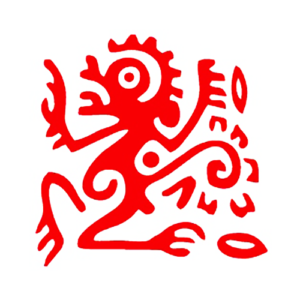
If we consider the form and design of logos and ancient symbols to encompass all perceptible patterns within a visual symbol, the general idea emerges that the symbols and myths of ancient peoples influenced even the design of the objects and buildings they used. Consequently, in the analysis of ancient works, special attention must be paid to the intellectual foundations and the diverse aspects of the symbology and mythological mindset of the designer who created the work, as well as the people who intended to use that product or building. Paying attention to this matter not only preserves the exclusive elements of each civilization but also leads to a deeper understanding of the background of each civilization and the people who lived within those cultures throughout the ages.
Historical Precedence: From Cave Art to Hieroglyphs
In the past, to communicate with others, humans engraved and drew various shapes and meaningful pictorial forms on stone or walls. The very ancient paintings and wall murals preserved in caves are part of the history of commercial logo, symbol, and mark design. Gradually, these simple images took the form of the alphabet. In essence, the letters of the alphabet are the transformed shapes of those old symbolic pictures, such as the civilization of ancient Egypt, where the Hieroglyphic alphabet was a form of inventing letters using pictorial symbols.
The Egyptians, like other civilizations of that era, used the design of rudimentary symbols to express intent. Hieroglyphic symbols were simply a collection of pictures, each representing an object found in nature—for example, the moon with a crescent shape, and water with a curved and wavy line, and so on.
However, these symbols could not express mental concepts through direct reference alone. For this reason, Hieroglyphics gradually shifted to also become signs of concepts (alongside representing physical examples). The next step in the development of that script, which coincided with the use of papyrus paper, was the use of various symbols to represent sounds, instead of relying purely on pictures with direct reference.
The Enduring Power of Symbols in Modern Communication
Expressing intent and meaning through the design of symbols and various shapes has a long history in human life. Even today, exclusive shapes and symbols are used to display a concept. Traffic signs and symbols are clear examples of the effective application of symbols on people’s minds, serving as an unwritten, international language understandable across the globe. This inherently proves the fact that images play an intensely valuable role in transmitting concepts.
When moving beyond the scope of pictures and discussing symbol design, the simpler they are, and the clearer they express their meaning, the higher their value. Furthermore, according to research conducted by scientists in recent years, the impact of symbols and images on better conceptual understanding and education has been proven. It is noteworthy that image-accompanied instruction is highly more effective, and the magnitude of the difference that images create in conceptual understanding is significantly large.
In a general view, the concepts we receive from any symbol are rooted in the mental history of humanity and the human lifestyle from ancient times. The recognition of concepts and the feeling that each symbol gives us are derived from the thoughts, feelings, and historical memory of the ancestors of humankind.